
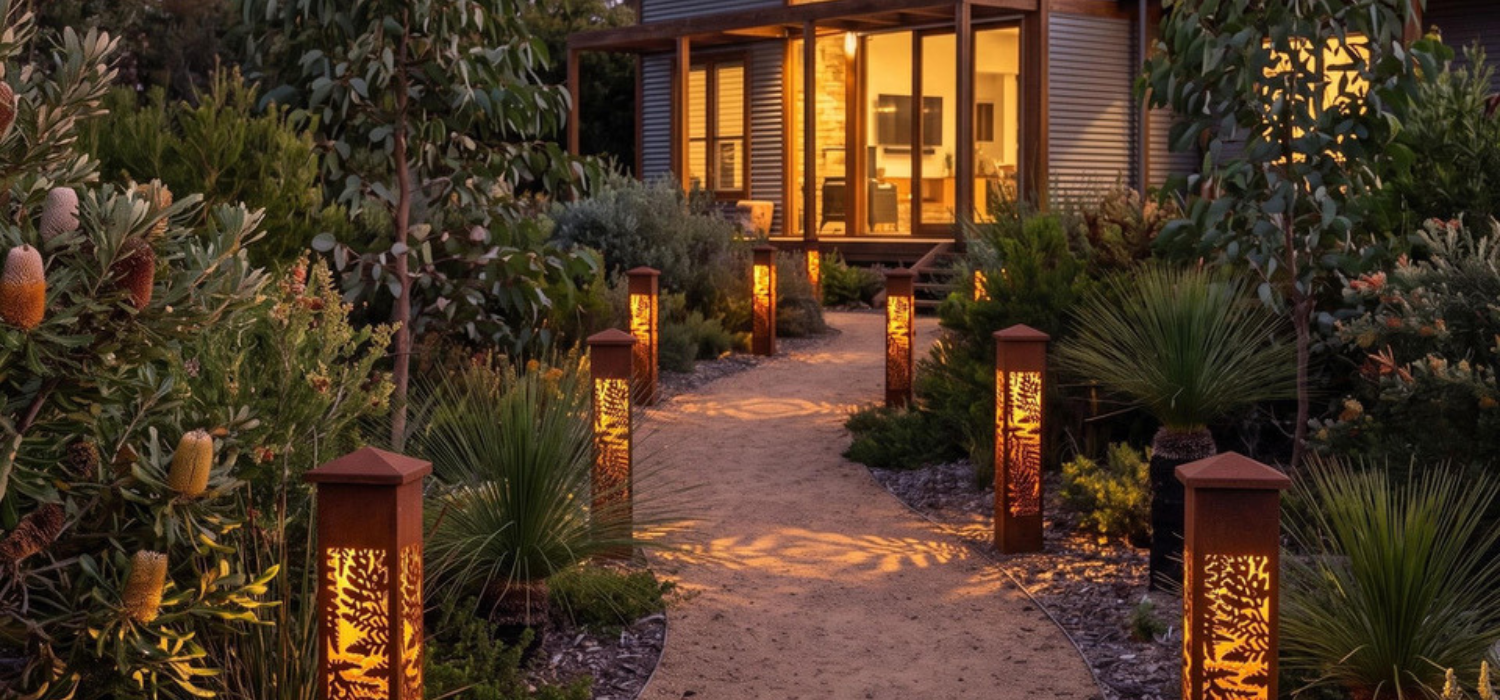
Garden bollard lights sit at the practical centre of the shift to eco-friendly outdoor lighting: low-voltage LED fittings that put light exactly where people walk, using around 80% less electricity than the halogen technology they replace, according to Australia's YourHome guide (updated 2025). A 7W LED fitting now matches output that once took a 35W to 50W halogen.
Two pressures are reshaping how this country lights its gardens: power bills that reward every watt saved and growing pressure to keep artificial light out of the night sky. The bollard format answers both at once, which is why it keeps earning its place in sustainable landscape design.
See the Corten bollard range at Koru Gum, or email sales@korugum.com for help matching heights to your paths.
Why Is Australia Pushing for Eco-Friendly Outdoor Lighting?
Australia is pushing for eco-friendly outdoor lighting because energy costs and night-sky pollution are climbing at the same time, and garden fittings sit where those two problems meet. Lighting takes around 5% to 10% of the average household electricity budget, according to Energy.gov.au, and outdoor circuits often run for hours every night of the year.
Regulation is moving in the same direction. Incandescent bulbs have largely left the Australian lighting market, and mains-voltage halogens follow wherever an LED equivalent exists, which is nearly everywhere.
The sky is the other half of the story. DarkSky International reported in April 2025 that light pollution is growing by nearly 9.6% a year worldwide, much of it from poorly aimed outdoor fittings. A garden light glowing softly at knee height is part of the answer; a floodlight blasting the fence line is part of the problem.
What Makes Garden Bollard Lights an Energy-Efficient Choice?
Garden bollard lights earn their efficiency through a frugal source and honest geometry: a low-wattage LED mounted low to the ground, so nearly every lumen lands where feet go. A modern bollard fitting draws 7W while producing 560 to 600 lumens, which works out above 80 lumens per watt from a fixture slimmer than a fence post.
Rated life does the rest of the work. A 30,000-hour LED running four hours a night lasts about 20 years before the fitting needs attention, and because the fixture is replaceable rather than sealed in, the steel body never becomes waste simply because a diode failed.
The 12V format keeps the whole system lean as well. Thin low-voltage cabling is straightforward to run through garden beds, and the 12V wiring and mounting guide shows typical layouts along with the separate transformer every low-voltage circuit needs.
How Do Bollard Lights Stack Up against Other Outdoor Lighting over a Decade?
Over ten years, a 12V LED bollard uses roughly one-seventh of the electricity of a 50W halogen flood and sends almost nothing to landfill, while throwaway solar stakes trade grid power for a steady stream of dead units. A decade is the fairest test of any garden fitting, because most of its footprint happens after you buy it.
The figures below assume four hours of use a night and typical retail specifications.
| Over 10 Years of Use | 240V 50W Halogen Flood | Budget Solar Stake | 12V 7W LED Bollard |
|---|---|---|---|
| Power drawn per fitting | 50W | 0W from the grid | 7W |
| Typical light output | 600 to 900 lm | 10 to 30 lm | 560 to 600 lm |
| Electricity used | ~730 kWh | 0 kWh | ~102 kWh |
| Hardware replaced | ~7 globes (2,000 hours of life) | 4 to 8 whole units (1 to 2 year life) | 0 to 1 LED fitting (30,000 h rating) |
| Landfill by year ten | A drawer of dead globes | Units with sealed batteries | Little to none; the steel body remains |
| Light spill | Wide, upward glare | Weak scatter | Low, patterned, aimed at the ground |
Energy figures are straight arithmetic: watts × 4 hours × 3,650 nights.
Why Does Koru Gum Design Its Bollard Lights in Corten Steel?
Koru Gum designs in Corten steel because the material protects itself: exposure builds a stable rust layer that needs no paint, powder coat or polishing for the life of the light. The bollards arrive already rusted, so the finish is working from day one and simply deepens with each season in the garden.
Every piece is designed in Sydney, and every pattern comes from the native flora of Australia and New Zealand: gum leaves, wildflowers, ferns and the unfurling koru. You can read the story behind the four designs and the two landscapes that shaped them.
That living surface is the sustainability argument. Stainless steel suits polished coastal builds and shrugs off salt, but it asks for regular cleaning to stay bright; corten wears the weather instead, there are no coatings to strip and reapply, and the steel itself is fully recyclable at the end of a very long life.
An efficiency gain hides in the aesthetics too. Each bollard reads as sculpture by day and projects patterned light by night, so one fitting does the visual work of several, and fewer fittings mean less draw.
What Should You Check Before Buying Eco-Friendly Outdoor Lighting?
Check output against draw before anything else: divide the lumens on the box by the watts, and treat 70 lumens per watt as the floor for an efficient garden fitting.
Then read the weather sealing. Australian lighting standards grade this with IP ratings, and IP44 is the sensible minimum for anything living outside. An IP65 fitting goes further, sealing out dust entirely and shrugging off rain jets, which is the rating our own fixtures carry.
Four more checks separate a durable buy from a disposable one: a replaceable LED fitting rather than a sealed unit, selectable colour temperature (3000K, 4000K and 6000K from one fixture), low-voltage 12V operation with its own transformer, and separate cover for the light and the housing. Our fittings carry a 12-month replacement warranty, with the Corten body covered separately.
None of this needs an electrician's vocabulary. Two numbers, one rating and a warranty card tell you most of what a spec sheet will.
How Do Garden Bollard Lights Cut Light Pollution at Home?
Garden bollard lights cut light pollution through geometry: the source sits below eye level and the patterned face throws light down and across the path, so very little escapes to the sky or over the fence.
Colour finishes the job. Warm 3000K light scatters less in the atmosphere and reads gentler at night than cool white, which is why a selectable fitting matters: crisp 6000K while you are working outside, 3000K once the garden is at rest.
Australia even has a standard for this. AS/NZS 4282 addresses the obtrusive effects of outdoor lighting, and low, shielded, warm fittings are the simplest way to stay on the right side of it. Put the circuit on a switch or timer so it runs only while the garden is in use, and a lit path stops costing the night sky anything.
What Do People Ask Most about Eco-Friendly Garden Lighting?
Five questions come up again and again, and each answer below stands on its own.
What Makes Outdoor Lighting "Eco-Friendly"?
Eco-friendly outdoor lighting delivers a lot of light for very little power, lasts tens of thousands of hours, and aims its beam only where it is needed. The housing matters as much as the lamp: durable materials and a replaceable fitting keep the whole unit out of landfill.
Are LED Garden Bollard Lights More Energy-Efficient Than Traditional Outdoor Lighting?
Yes. LED garden bollard lights convert far more power into light than the halogen fittings they replaced. Typical LEDs produce 60 to 130 lumens per watt against under 20 for halogen, so a 7W bollard now delivers brightness that once required a fitting several times its draw and running cost.
Does Low-Voltage Garden Lighting Use Less Energy Than Standard Mains Lighting?
Not automatically: energy use follows the wattage a fitting draws, not the voltage it runs at. In practice, though, 12V garden systems are built around low-draw LED fittings of about 7W, while mains circuits often carry high-wattage floods, so a low-voltage layout almost always draws far less power.
Is Corten Steel a More Sustainable Material for Outdoor Lighting Than Plastic or Painted Metal?
Yes, over its working life. Corten grows a protective rust layer instead of relying on paint or powder coat, so nothing peels, fades or needs solvent-based refinishing. Plastic housings embrittle under Australian UV and end up in landfill, while Corten lasts decades outdoors, and the steel is fully recyclable when it finally retires.
How Can Homeowners Reduce Light Pollution with Garden Bollard Lighting?
Keep fittings low, warm and switched. Set bollards to 3000K after dark, choose heads that push light down at the path rather than sideways, space them only where people actually walk, and put the circuit on a switch or timer so the garden goes properly dark when nobody is out in it.
So Where Do Garden Bollard Lights Fit in an Eco-Friendly Australian Garden?
They fit right at the front of it: garden bollard lights prove the eco-friendly brief can be met without the result looking like a compliance exercise. Seven watts a fitting, decades of rated life, a material that maintains itself and light that stays out of the sky is not a compromise; it is the standard the rest of outdoor lighting is being pulled towards.
The maths holds over a decade, the corten holds for longer, and the pattern makes each fitting worth looking at in daylight. Plan yours with Koru Gum: email sales@korugum.com or send your path measurements through the contact page, and we will help you map heights and spacing to your garden.